

The Epstein Files & The Origin of Evil: What the Bible Really Says

An example of the Epstein Files
When the Epstein files began flooding the public domain, millions of people stared at their screens, asking the same question: How could human beings be this evil?
But the Bible suggests we're asking the wrong question. The more important question is: Why do we think we're any different?
As Ecclesiastes 1:9 reminds us, there is nothing new under the sun.
It Started Before the Garden
To understand the depth of human corruption, we have to go further back than Adam and Eve. We have to go to heaven itself.
Scripture reveals that before humanity ever sinned, pride had already corrupted one of God's most exalted created beings. Isaiah 14:13–14 captures the heart of this rebellion: "I will ascend. I will make myself like the Most High." Ezekiel 28:15 and 17 add that this being — Lucifer — was blameless until unrighteousness was found in him, and that his downfall came through pride in his own beauty.
Here's the critical point: Satan was not created evil. He chose it.
God did not create robots. He created beings capable of genuine love, genuine allegiance — and therefore genuine rebellion. The capacity for real worship requires the possibility of real defection.
When Lucifer fell, he didn't dethrone God. He revealed that no created being can rival Him. Revelation 12:9 shows him cast down, his rebellion permitted but not unchecked, with God remaining sovereign throughout.
The Fall in the Garden
That same pride that said "I will ascend" in heaven soon whispered something equally seductive in the garden: "You will be like God." (Genesis 3:5)
The serpent's approach was not open hatred — it was subtle distortion. "Did God actually say...?" (Genesis 3:1). The temptation was brilliant in its simplicity: Adam and Eve were already made in God's image, already walking with Him. Yet the desire to define good and evil for themselves — to rule independently rather than in relationship — replaced trust in God's word.
When they ate, everything changed. Shame replaced innocence. Hiding replaced fellowship. Death entered creation. But notice what the first sin was really about: it wasn't about fruit. It was about autonomy. The human heart chose independence over obedience, and that decision altered human nature itself.
Why Do We Still Pay for Adam and Eve's Sin?
This is one of the most common questions asked about faith, and it's a fair one. It seems deeply unfair — one mistake in a garden thousands of years ago, and yet here we are living with pride, corruption, and death all around us.
The key is understanding what Adam represented. He wasn't merely a private individual making a personal mistake. He was humanity's representative. Romans 5:12 teaches that sin entered the world through one man, and death through sin, spreading to all.
Think of it like voting. When you vote for someone to represent you, their decisions carry weight on your behalf — for better or worse. Adam was that representative for all of mankind, and when he chose rebellion, that choice rippled outward.
But here's what's equally important: we are not passive victims of his choice. Romans 3:23 says, "all have sinned." We confirm Adam's rebellion daily. James 1:14–15 explains that sin flows from our own desires. We sin because our nature is already bent away from God — and because we keep bending it further.
Yet Scripture offers a stunning parallel. Romans 5:18–19 presents a second representative: Jesus Christ. Just as one man's trespass brought condemnation, one man's act of righteousness brings justification for all who believe. The problem isn't only what Adam did — it's what we continue to do. And the solution isn't only what we stop doing — it's who we place our trust in.
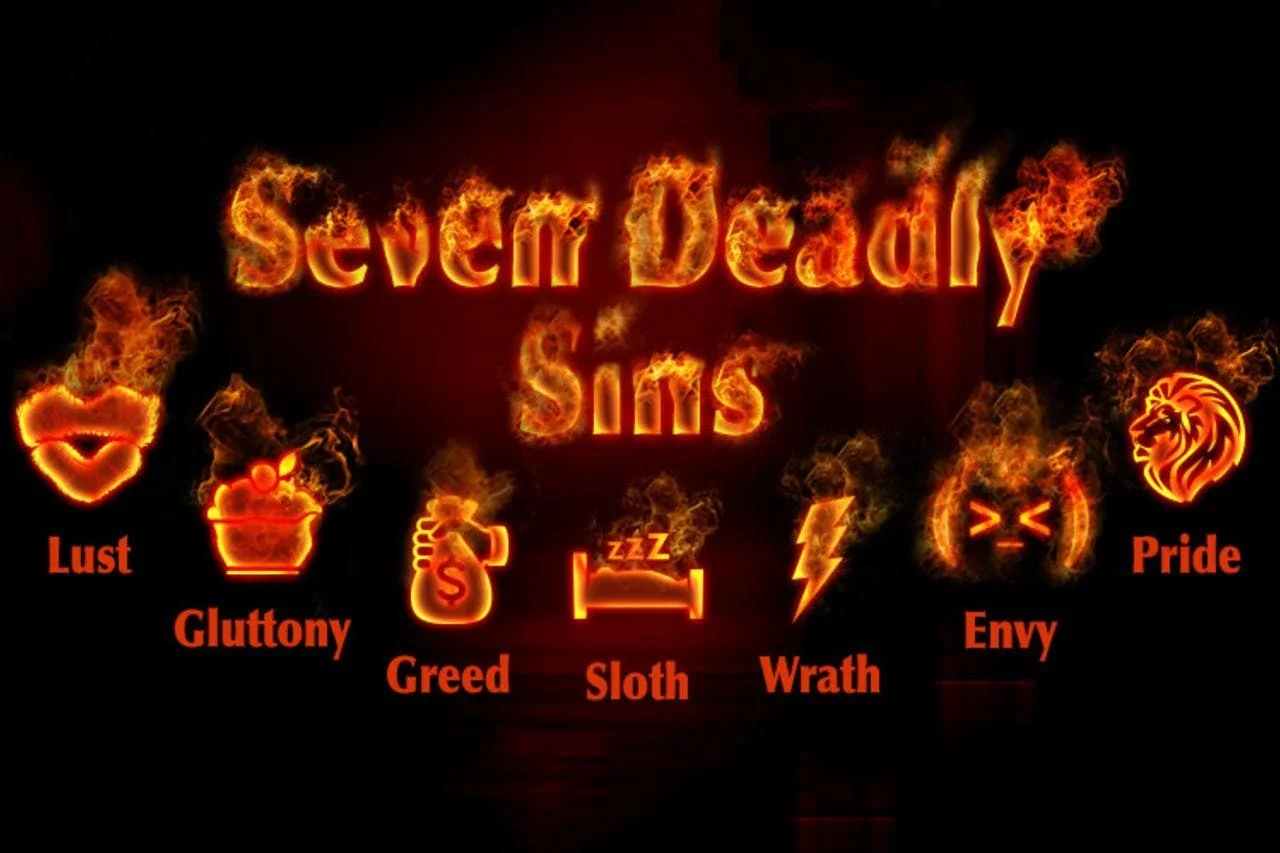
Seven Deadly Sins
The Seven Deadly Sins — Ancient Patterns, Modern Faces
Though the term "seven deadly sins" developed later in church history, every one of them reflects a biblical truth. They're not isolated behaviors — they are symptoms of humanity seeking fulfillment apart from God. They are the fruit of the same pride that began in heaven and blossomed in Eden.
Pride goes before destruction (Proverbs 16:18)
Greed — the love of money is the root of all kinds of evil (1 Timothy 6:10)
Lust begins in the heart (Matthew 5:28)
Envy produces disorder (James 3:16)
Wrath — human anger does not produce God's righteousness (James 1:20)
Gluttony and overindulgence lead to ruin (Proverbs 23:20–21)
Sloth results in decay (Proverbs 19:15)
These patterns don't disappear in a society with skyscrapers and stock markets. They evolve, and they amplify — especially when they're combined with wealth, influence, and power.
The Epstein Files: An Ancient Problem in Modern Form
Jeffrey Epstein — a wealthy financier convicted of sexually abusing minors and orchestrating networks of exploitation — became a focal point for public outrage in recent years. In late 2025, the US Epstein Files Transparency Act became law, requiring the Department of Justice to release all unclassified records, communications, and investigative materials related to the case. As millions of pages began flowing into the public domain, the world got an uncomfortable look at what power without accountability can become.
Every one of the seven deadly sins appears in this story. Wealth and power became tools of control and indulgence. Lust and exploitation targeted the most vulnerable. Pride, envy, and the hunger for status drove destructive choices. And those who could have stopped it — in many cases — simply didn't. The sloth of complicity is its own category of failure.
John 3:19 says that people love darkness rather than light because their deeds are evil. Jesus teaches that evil actions flow from within the heart (Mark 7:21–23). Wealth and influence don't create sin — they magnify what is already present.
Every public scandal is a reflection of an ancient spiritual problem. The issue is not simply systems or status. The issue is the human heart.
A Word on Justice — and Discernment
With so many names surfacing in these files, it's important to be clear about something: inclusion in the files does not automatically imply criminal wrongdoing. Some documents show correspondence or social contact — a flight log, an email, an introduction at an event. Appearance in the files is not proof of illegal activity. Journalists and legal analysts have emphasized this distinction repeatedly.
Scripture calls us to uphold justice: "Learn to do good; seek justice, correct oppression" (Isaiah 1:17). But it also warns against bearing false witness (Exodus 20:16). The proper response is not blanket condemnation of everyone whose name appears, but sober investigation, careful discernment, and respect for due process. God's justice seeks truth, protects the innocent, and holds the guilty accountable — not based on speculation or rumor, but on clear evidence and fair examination.
Revelation and the Hidden Things
There's a reason the Epstein files evoke something almost apocalyptic in the cultural imagination. They mirror what the book of Revelation describes: the unseen workings of evil in the world, the exploitation of the vulnerable, and the judgment that comes when darkness is brought into the light.
Revelation 18 describes the fall of Babylon — a symbol of systemic corruption, pride, and indulgence. Babylon represents societies that exalt themselves, exploit others, and use manipulation and wealth to escape accountability. Like Babylon, the Epstein situation reveals that hidden sin has a way of being exposed, no matter how carefully it is concealed.
Revelation 20:12–13 speaks of the dead being judged according to what they have done. The files function as a modern echo of God's principle: secrecy cannot hide wrongdoing forever, and every action eventually bears consequences. Revelation teaches that ultimate accountability lies with God. Corruption cannot remain hidden forever. Truth and justice will prevail even when the powerful try to escape them.
The Story Doesn't End in Corruption
First Corinthians 15:45 calls Jesus the last Adam. Where the first Adam grasped for autonomy, Christ humbled himself (Philippians 2:6–8). Where pride brought death, obedience brought life. Romans 6:23 declares: "The wages of sin is death, but the free gift of God is eternal life in Christ Jesus our Lord."
The curse introduced in Eden can be broken through Christ. The image of God in humanity can be restored. The biblical story — from creation to fall, from rebellion to corruption — ultimately points to redemption.
The desire to rule apart from God leads to death. Surrender to Christ leads to life.
Where Do You Go From Here?
If you're in the middle of a spiritual journey and things in church don't quite make sense yet, consider starting with the book of John. Unlike most New Testament writers who were addressing existing believers, John wrote specifically for those who don't yet believe. He walks through simply and clearly what it means to be saved and how to get there. It might surprise you how accessible it actually is.
